
Sectors we serve
Agriculture & Mining
Farms and mining operations run their biggest loads in daylight, exactly when solar produces most. Grid-tied and ground-mounted PV, with storage where it makes sense, keeps pumping, cold storage, packing and working sites running reliably and affordably.
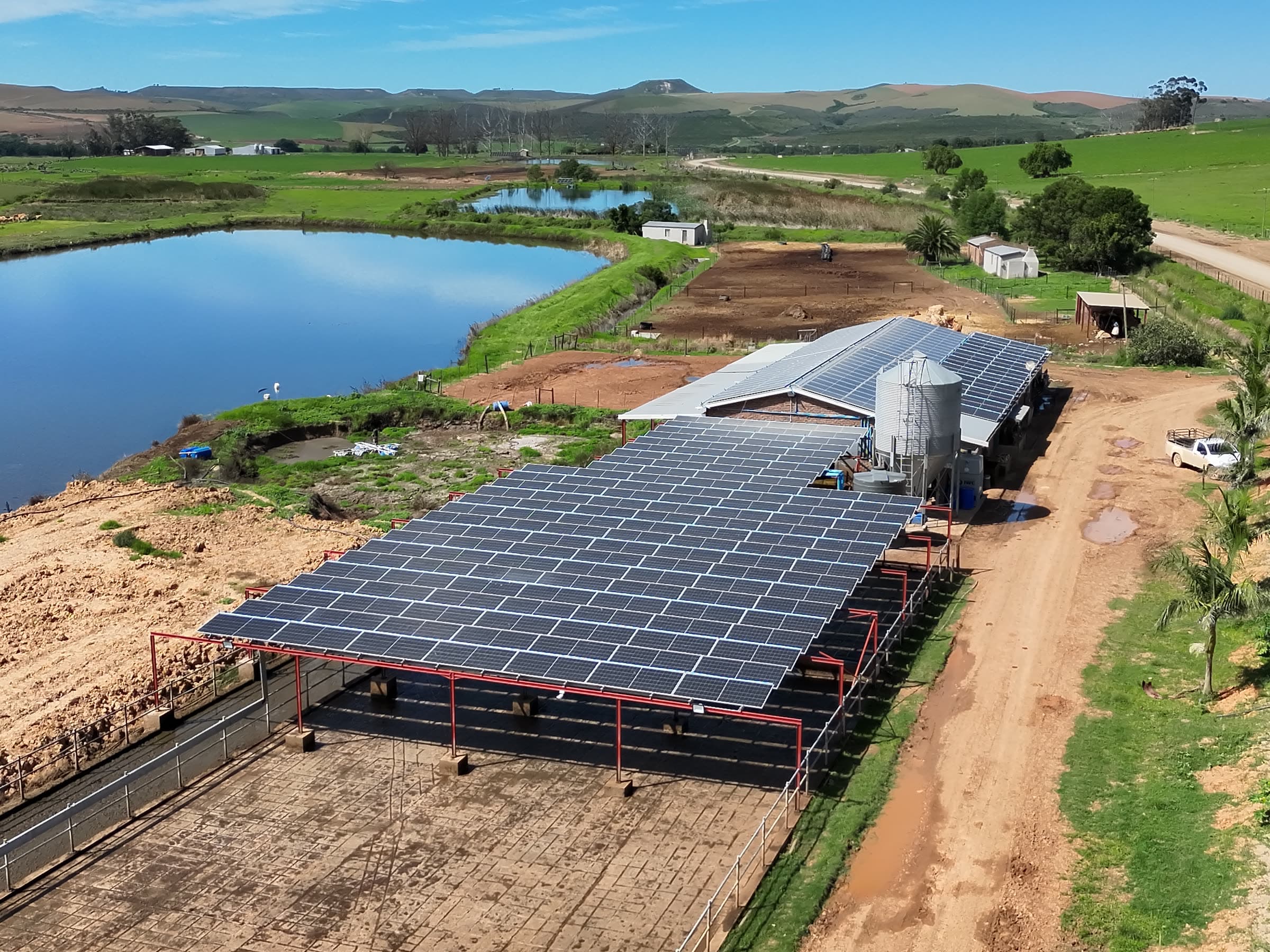
Why solar works here
- Power for pumping, refrigeration and packing when you need it most.
- Ground-mounted systems where roof space is limited.
- Reduce diesel and grid dependence on demanding, high-load sites.
How a farm uses power
Farm loads follow the working day and the season. Milking, milk cooling, packing, cold storage, workshops and pumping loads all draw power, much of it in daylight and much of it concentrated in harvest or peak production months. That makes agriculture one of the most natural fits for solar PV.
Supply is the other half of the picture. Many farms sit at the end of long rural Eskom lines, where interruptions, voltage dips and slow fault repairs are common, and where the available supply capacity can limit new equipment. Diesel generators fill the gaps at a running cost that is hard to control. A well designed system reduces grid and diesel dependence and keeps the loads that protect product and animals running.
Some loads do not follow the sun. Early morning milking, overnight refrigeration and ventilation in poultry houses run around the clock. Those are the loads where battery storage earns its place, and where we spend the most time getting the sizing right.
What we typically install
Ground-mount PV
Farms often have land that suits a ground-mounted array close to the main load. Ground mounts are straightforward to clean, inspect and extend. One of our agricultural installs is a 130 kWp ground-mount system.
Rooftop PV on sheds and packhouses
Large shed, packhouse and dairy roofs suit PV well once their structure has been checked.
Canopy structures
PV canopies over dairy and feeding areas or vehicle parking generate power and give shade, on space that is already working.
Grid-tie systems
Where supply is stable and the aim is lower daytime consumption, grid-tie is the simplest route. One agricultural site runs 480 kWp of grid-tie PV.
Hybrid systems with BESS
Storage carries milking, cooling, refrigeration and ventilation through interruptions and into the evening. A milk farm we installed runs 225 kWp of PV with 150 kW of Sigenergy inverters and 324 kWh of storage; another agricultural site runs 95 kWp with 175 kW of Sigenergy inverters and 324 kWh.
Generator integration
Where a generator stays on site, the system is designed to work alongside it, so the generator runs fewer hours and starts when it is genuinely needed.
Typical farm applications
Milking and dairy
Milking machines, vacuum pumps and milk cooling. Cooling straight after milking protects milk quality, so it is usually on the backed-up circuit.
Cold storage and refrigeration
Cold rooms run day and night. Solar carries much of the daytime load, and storage protects stock through interruptions.
Packhouses
Grading lines, conveyors, forced-air cooling and lighting, heaviest during harvest. Sizing accounts for both the seasonal peak and the quieter months.
Pumping loads
Pumps are large and often controllable. Where the operation allows, scheduling them into solar hours makes better use of the system's output.
Poultry
Ventilation, heating, lighting and feeding systems. Ventilation keeps the birds alive, so backup design gets particular attention.
Orchards and feedlots
Fruit cold storage, feed mills, mixers, workshops, and the lighting and security that run across the property.
What we assess on a farm
Consumption and supply
- Twelve months of Eskom or municipal bills, per meter where the farm has several
- Seasonal load profile: harvest, milking and cooling cycles
- Supply capacity and the condition of the rural connection
- Generator size, fuel use and running hours
Site
- Land for ground mounting: slope, soil, access and distance to the main load
- Structural assessment of shed, packhouse and dairy roofs
- Shading from trees, silos and terrain
- Cable routes between the array, the inverters and the distribution board
Operation
- Critical loads: cooling, refrigeration, ventilation and milking
- Planned expansion of herds, cold storage or processing
- Fire breaks, livestock movement and vehicle access around the array
Paying for it and keeping it running
A farm system can be paid for through a PPA, an installment sale, rental or outright purchase. A PPA or rental keeps capital in the operation for livestock, equipment and inputs. Outright purchase gives you the asset and, for a qualifying farming business, access to the Section 12B allowance. We set out each model against your figures, and your financial adviser confirms the tax position.
Farms are dusty, and soiling reduces output. Remote monitoring lets our team see production and battery health from either branch, and scheduled preventative maintenance covers panel cleaning, mounting and cabling inspections, rodent and fire-risk checks, thermal scans and inverter and battery servicing. We plan site visits around the farming calendar, not the other way round.
Agriculture questions
Can solar run our milking before sunrise?
Not directly, because PV produces nothing before sunrise. A battery charged the previous day, or the grid, carries early milking, and we size storage for that window specifically.
We have several Eskom points of supply. Can one system serve them all?
Each point of supply is usually treated separately, because each is metered separately. We look at every meter and recommend where a system does the most good, which is usually the largest daytime load.
Does a ground-mount system take land out of production?
It uses some land. Where possible we place it on the least productive ground near the load, and the footprint is shown in the proposal so you can decide with the full picture.
What happens at harvest, when the load is at its peak?
The grid or generator makes up any shortfall automatically. We size for the whole year, so the system is fully used in quieter months and makes a solid contribution at peak.
Planning a agriculture & mining installation?
Every system starts with a consult and site audit on your actual usage and load profile.
Power On!