
Sectors we serve
Commercial & Industrial
Commercial and industrial sites with high daytime consumption are where solar delivers the fastest, clearest return. We engineer rooftop and ground-mounted PV, with battery storage where it earns its place, around your operation's actual load profile.
Why solar works here
- Reduce operating costs on your largest daytime loads.
- Protect the operation against rising tariffs and grid outages.
- Systems sized to your usage, from office and business parks to manufacturing and galvanising plants.
How a commercial site uses power
Most commercial and industrial sites draw the bulk of their electricity during working hours: office HVAC and lighting, production lines, compressors, motors, process heating and the IT that holds it all together. That daytime profile lines up closely with PV generation, which is why solar on a business is mostly used on site rather than exported.
The bill is rarely just energy. Larger supplies on Eskom or municipal time-of-use (TOU) tariffs pay different rates for peak, standard and off-peak periods, plus network and demand charges based on the highest demand recorded in the month. Solar reliably reduces the energy (kWh) part of the bill. Reducing demand charges needs battery storage controlled to shave the peaks, because a passing cloud can remove PV output at exactly the wrong moment. We model both honestly and do not count on demand savings the design cannot deliver.
Then there is reliability. A grid interruption stops a production line, spoils a batch or sends staff home, and many sites still lean on diesel generators that are costly to run and maintain. A hybrid system with a battery energy storage system (BESS) carries the loads that matter through an outage and cuts generator running hours, sized to what the business actually needs to keep running.
What we typically install
Every commercial system is designed around the site's load profile, so the mix below changes from one project to the next.
Rooftop PV
Most C&I systems start on the roof. Factory, warehouse and office roofs are assessed structurally, laid out for production and maintenance access, and fitted with mounting suited to the sheeting profile.
Carport and canopy PV
Where roof space is short or unsuitable, solar carports over staff and visitor parking add generation on ground that is already in use, with shade as a by-product.
Ground-mount PV
Sites with spare land can take a ground-mounted array, which is easier to orient, clean and extend than a roof.
Grid-tied systems
The simplest route for sites that mainly want to reduce daytime grid consumption, configured with export limiting where the utility requires it.
Hybrid systems with BESS
Inverters and battery storage that shift solar energy into the evening, shave demand peaks and carry critical loads through grid interruptions.
Monitoring
Every system is commissioned with inverter and battery monitoring, so production, consumption and battery state are visible remotely to you and to our team.
Grid-tied or hybrid?
The right choice depends on how much an interruption costs the business and how the tariff is structured.
| Aspect | Grid-tied | Hybrid with BESS |
|---|---|---|
| Main purpose | Reduce daytime grid consumption | Reduce consumption, shift energy and back up critical loads |
| During a grid outage | Shuts down for safety, as the grid code requires | Keeps agreed critical loads running for the designed duration |
| TOU and demand | Reduces energy charges during solar hours | Can also discharge into peak periods and shave demand |
| Relative capital | Lower | Higher, depending on storage size |
| Best suited to | Stable supply and a strong daytime load | Sites where downtime, diesel or peak tariffs carry a real cost |
Typical commercial and industrial applications
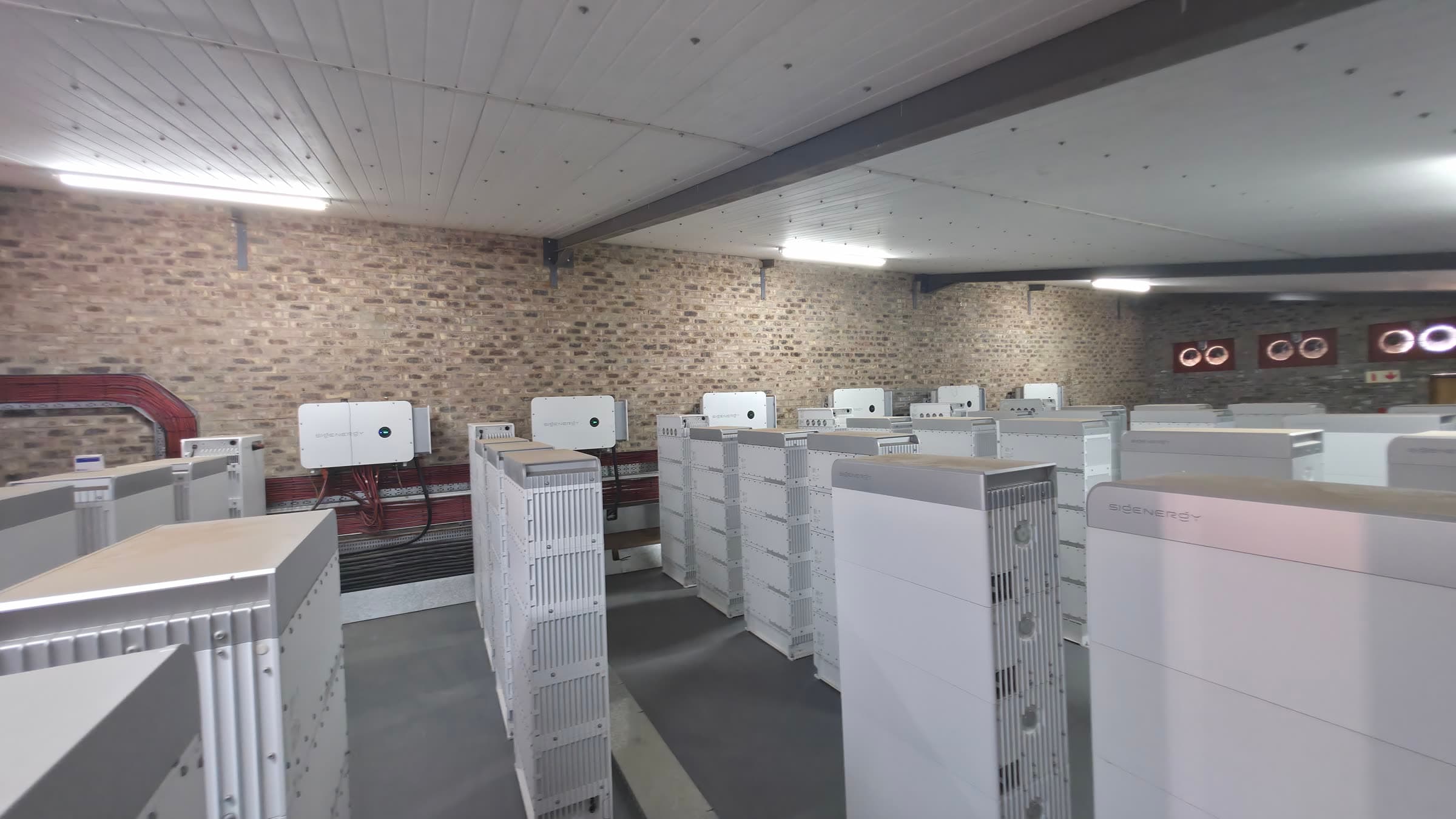
Systems we have commissioned include a commercial plant with 1 500 kWp of PV, 950 kW of Sigenergy inverters and 3 000 kWh of battery storage; a galvanizing plant with 437.8 kWp of PV, 300 kW of Atess inverters and 1 024 kWh of Highon storage; a business park with 54 kWp, a 100 kW Atess inverter and 150 kWh of Highon storage; and a business with 51.15 kWp, a 50 kW Deye inverter and 60 kWh of Highon storage.
Offices and business parks
Daytime HVAC, lighting, lifts and IT. Backup is usually focused on server rooms, access control, security and essential lighting.
Manufacturing lines
Motors, conveyors and controls. Solar offsets daytime production, and storage protects lines and control systems from interruption.
Compressors and HVAC
Compressed air and chillers are among the largest continuous loads on many sites, so they get close attention in the load profile study.
Galvanizing and process plants
Heavy, sustained process loads plus cranes and handling equipment, with storage sized to protect the process rather than the whole site.
Warehousing and distribution
Lighting, automation, forklift charging and cold rooms, often across extended shifts.
What we assess on your site
Your consumption
- Twelve months of electricity bills, or interval metering data where it exists
- Tariff structure, TOU periods and notified maximum demand
- Load profile by hour, weekday and weekend
- Critical loads and how long they must run in an outage
- Current generator use, fuel and running hours
Your site
- Structural roof assessment: sheeting, purlins, age and load capacity
- Available roof, parking and land area
- Shading from neighbouring buildings, plant and trees
- Main distribution board, supply capacity and the municipal or Eskom connection
- Space and ventilation for inverters and battery storage
Your plans
- Planned expansions, new lines or extra shifts
- Lease terms and roof ownership
- Approvals: SSEG application, utility consent and landlord sign-off
Paying for it and looking after it
A commercial system can be paid for in four ways. Under a power purchase agreement (PPA), SolarSkye funds the system and you buy the electricity it produces at an agreed rate, with no capital outlay. An installment sale spreads the cost over an agreed term, after which you own the system. Rental gives you a fixed monthly rate over the lease term with no deposit. Outright purchase gives you the asset, and qualifying businesses can claim the Section 12B allowance. We set out each model against your figures in the proposal, and your financial adviser confirms the tax position.
Once commissioned, the system is monitored remotely, and scheduled preventative maintenance covers panel cleaning and inspection, thermal scans of connections, inverter and battery health checks and the compliance documentation your site needs. Our electrical services division looks after the rest of the installation too, including generators, UPS and 24/7 emergency breakdown, so one team is accountable for the whole supply.
Commercial and industrial questions
How large a system does my business need?
It depends on the load profile, not the floor area. We size from at least twelve months of consumption data so that most of the solar energy is used on site during working hours. Oversizing a system that cannot export usually wastes generation.
Can we export surplus power to the grid?
Sometimes. Export depends on your municipality or Eskom, the connection and the applicable SSEG rules, and it is often limited or not credited. We design for self-consumption first and configure export limiting where it is required.
Will the system keep us running during load-shedding?
A grid-tied system will not; it shuts down when the grid does. A hybrid system with battery storage keeps the loads it was designed for running. We agree those critical loads and the backup duration with you before design.
Will installation disrupt production?
Most roof and plant-area work carries on around normal operation. Connecting to the main board needs a planned shutdown, which we schedule with you, often over a weekend or outside shift hours.
Planning a commercial & industrial installation?
Every system starts with a consult and site audit on your actual usage and load profile.
Power On!