
Sectors we serve
Residential
Homes, estates and complexes are served by the same in-house team and engineering standard as our commercial work. Reliable power and lower bills, built to last.
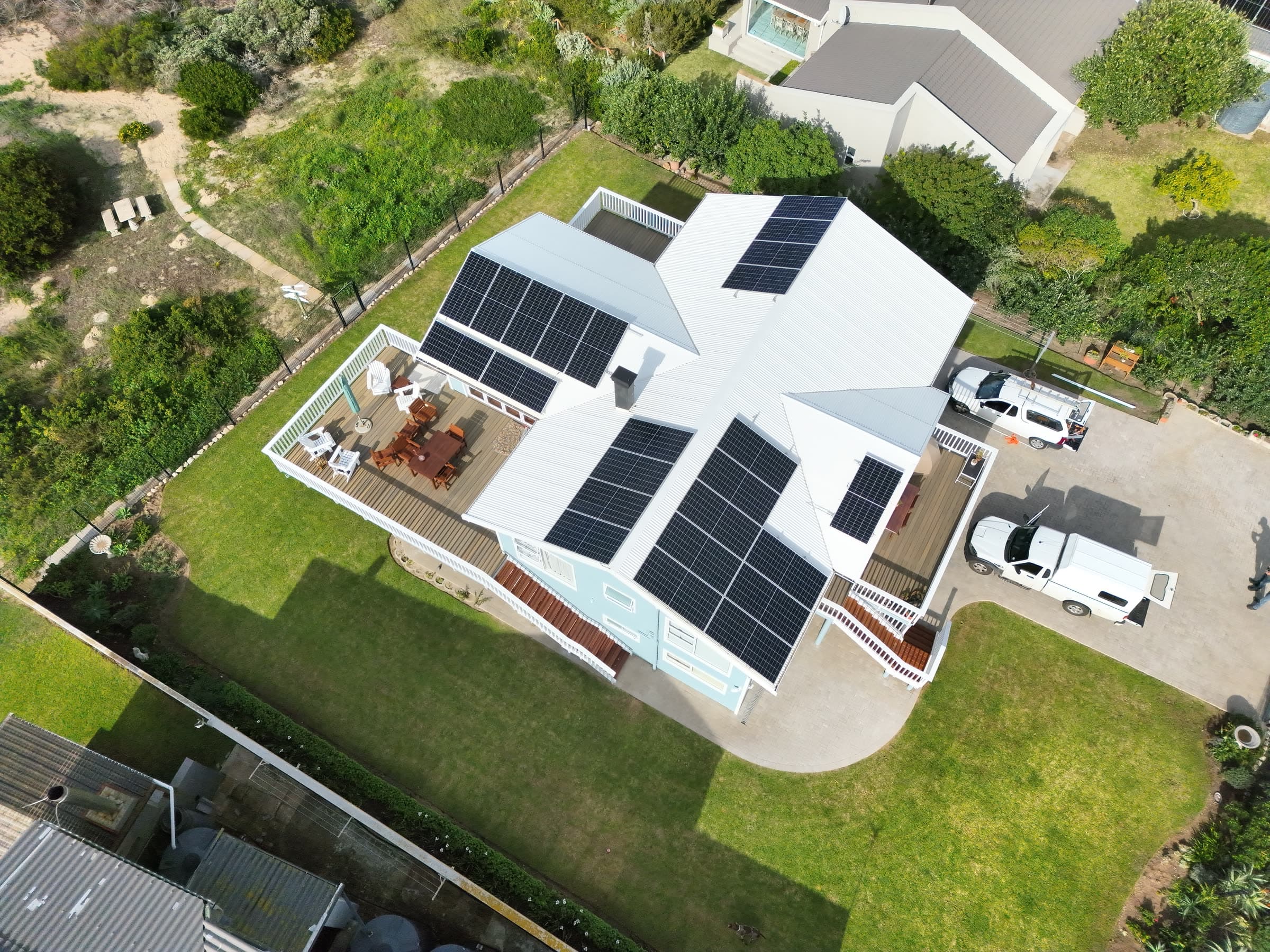
Why solar works here
- Independence from rising costs and unreliable supply.
- The same engineering standard as our commercial installs.
- Backed by a full in-house team and 25+ year systems.
How a home uses power
Household consumption peaks in the morning and the evening, when people are home, cooking and using lights, with a lower load during the working day. Geysers, ovens, heaters and air conditioners are the heavy loads; lights, fridges, Wi-Fi, TVs, alarms and gate motors are the loads most families want kept on.
Because a home uses less during the day, a residential system usually pairs PV with a battery, so energy generated while the house is empty is stored for the evening. The result is a home that keeps its essentials running through load-shedding and buys less from the grid.
What we typically install
Hybrid inverter and battery
The usual residential system: PV on the roof, a hybrid inverter and lithium battery storage that covers essential loads through interruptions and shifts solar energy into the evening.
Essential-load circuits
We separate the circuits that matter in an outage, such as lights, plugs, fridge, Wi-Fi, alarm and gate motor, so heavy loads do not drain the battery.
Rooftop PV
Panels laid out for the best production the roof allows, with mounting suited to tile or sheeting roofs.
Estates and developments
The same engineering at scale for estates and developments. One property development we worked on carries 1 080 solar geysers.
Monitoring
An app shows production, consumption and battery state, and lets our team see faults remotely.
What we assess at your home
Usage
- Twelve months of municipal or Eskom bills, or prepaid purchase history
- The loads you want running in an outage
- Heavy loads and when they run
Roof and electrics
- Roof type, condition, orientation and pitch
- Shading from trees, neighbouring buildings and chimneys
- Distribution board condition and space for the inverter and battery
- Earthing and the existing certificate of compliance
Approvals and plans
- Municipal SSEG registration requirements
- Body corporate or homeowners' association approval and estate architectural guidelines
- Future plans such as an extension, an electric vehicle or more occupants
Estates, complexes and body corporates
In sectional title schemes and estates, the roof and the look of the building are shared. Installations usually need body corporate or homeowners' association approval, and many estates have architectural guidelines on panel placement and visible equipment. We prepare the layout drawings and technical information those approvals ask for.
For complexes and developments, a scheme-wide approach can serve common areas, gate and security systems and individual units in a planned way, rather than leaving every owner to appoint a different installer.
Paying for it and looking after it
Homeowners can buy a system outright or spread the cost through an installment sale or rental. Which models are available for a home depends on the system and the finance partner, and we set out the options with the proposal. Power purchase agreements are generally used for commercial systems, and the Section 12B allowance applies to businesses rather than households.
Every residential system is installed by our own team, to the same standard as our commercial work, with a certificate of compliance on completion. The system can be monitored remotely, and scheduled maintenance keeps panels, connections and batteries in good condition for the long term.
Residential questions
How big a battery do I need?
It depends on which loads you want running and for how long. We size it from your essential loads and your usage, not from a standard package.
Can I add more panels or batteries later?
Usually, if the inverter and battery are chosen with expansion in mind. Tell us your plans and we design for them from the start.
Do I need to register my system with the municipality?
In most municipalities, yes. Grid-connected systems, including hybrid systems, generally need to be registered as an SSEG. We prepare the documentation as part of the installation.
Will the system work during load-shedding?
A hybrid system with a battery keeps your essential circuits running for as long as the battery and the sun allow. A grid-tied system without a battery shuts down when the grid does.
Planning a residential installation?
Every system starts with a consult and site audit on your actual usage and load profile.
Power On!